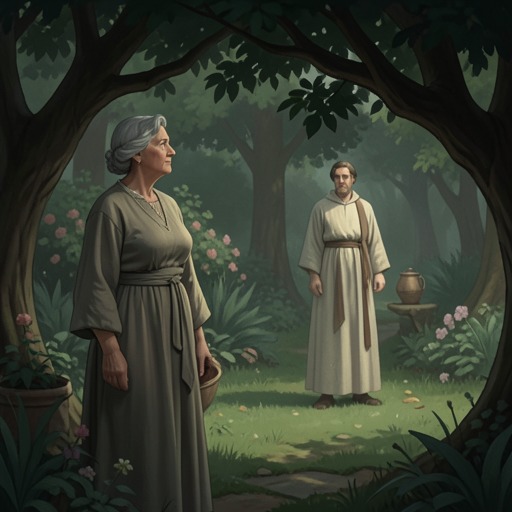
Baby Kochamma’s obsession with Father Mulligan
The God of Small ThingsBaby Kochamma’s obsession with Father Mulligan is sustained by ritual repetition and possessive memory: long after he has rejected her, changed his faith, and died, she continues to write that she loves him and imagines him restored to the Catholic priest she once desired. His death does not end the attachment; it removes the living man’s capacity to contradict the version of him she keeps for herself.
Diary and Repetition
On 19 June, Baby Kochamma opens her maroon diary and makes a fresh entry. The act is routine, and the words are the same as those on every page: “I lovc you I love you.” The first word is misspelled, but the phrase recurs so insistently that the diary becomes less a record of changing days than a mechanism for keeping one feeling in place.
She owns a case full of diaries with identical entries. Some pages also contain the day’s accounts, to-do lists, or fragments of dialogue from favorite soap operas, but even these more practical or incidental records begin with the declaration of love. The format absorbs ordinary life into the repetition: daily business may vary, but the opening words do not. Her attachment is therefore represented not as a single remembered episode but as a practice carried forward page after page.
The night’s entry belongs to a much longer pattern. After writing, Baby Kochamma returns the pen to its loop and shuts the diary, completing a small, familiar sequence before bed. The physical book gives her feeling an enduring form, while its identical entries make that endurance visible as both devotion and fixation.
Father Mulligan’s Change of Faith
Father Mulligan died four years before this scene of viral hepatitis in an ashram north of Rishikesh. His path to that ashram had begun in contemplation of Hindu scriptures: theological curiosity eventually became a change of faith, and fifteen years before his death he became a Vaishnavite devotee of Lord Vishnu. Even after joining the ashram, he kept in touch with Baby Kochamma, writing to her every Diwali and sending a greeting card each New Year.
A photograph he sent a few years before his death confronted her with the distance between the man she remembered and the life he had chosen. It showed him addressing middle-class Punjabi widows at a spiritual camp, the women in white saris with their pallus drawn over their heads and Father Mulligan dressed in saffron. His long white beard and hair were combed and groomed. To Baby Kochamma, the image made his conversion unmistakable: the priest she had loved had become a religious figure among people and vows that were not hers.
She had kept what he sent her, but not this photograph. She was offended that Father Mulligan had eventually renounced his vows, not for her, but in order to take up other vows. The hurt is figured as a failed welcome: she had imagined opening her arms to him, only for him to pass her by and enter another life. His continued correspondence had not erased that rejection; the photograph made its meaning newly plain.
Possession Through Memory
Death does not alter the diary’s declaration because, in Baby Kochamma’s view, it does not alter Father Mulligan’s availability to her. Indeed, she feels that she possesses him more completely after his death than she ever did while he lived. The distinction is crucial: while alive, he could choose another faith and remain separate from her; in memory, he belongs to her alone.
She treats that memory as private territory, fiercely guarded against the people and communities associated with his later religious life. The language of possession turns the absence of the living man into an imagined intimacy: no competing devotees can claim the version of him she remembers. His death has neutralized, in her mind, the gentle and compassionate rejection she experienced in life. In the recollection she constructs, he embraces her as a man embraces a woman.
That imagined embrace depends on replacing the visible evidence of his changed life. Baby Kochamma strips away the saffron robes and puts him back in the Coca-Cola cassock she loved. She takes away his begging bowl, restores his comfortable sandals, and imagines him once again as the priest who came to lunch on Thursdays. The transformation is physical and specific: the saffron-clad Vaishnavite of the photograph is made over into the familiar Father Mulligan of her desire. Memory does not reconcile her to his choice; it reverses it.
The Meaning of the Obsession
The diary and the remembered body perform complementary work. The diary repeats Baby Kochamma’s words without changing them; her imagination changes Father Mulligan until he can fit them. One preserves the declaration, while the other revises its object. Together they allow an affection unanswered in life to persist as a private arrangement in which rejection no longer has the final say.
The scene also sets the measured routine of the diary against the intensity of the claim it contains. Night after night, year after year, Baby Kochamma writes the same words. This recurrence is not evidence that the relationship has developed or been returned; it marks the opposite, a life in which the written expression remains fixed while the other person’s history has moved through conversion and death. The remembered priest is thus less the man as he lived than a figure she can summon and re-clothe.
The scene closes the nightly ritual rather than resolving the attachment. Baby Kochamma shuts the diary, removes her glasses and dentures, and settles into bed. She then waits to hear Rahel come out of Estha’s room. That final detail places her solitude beside the continuing life of others: even as she keeps Father Mulligan alive in a memory wholly her own, her attention remains turned toward what is happening elsewhere in the house. The diary’s last entry is only one night in an unbroken series, and the obsession remains intact.